
EN / PT

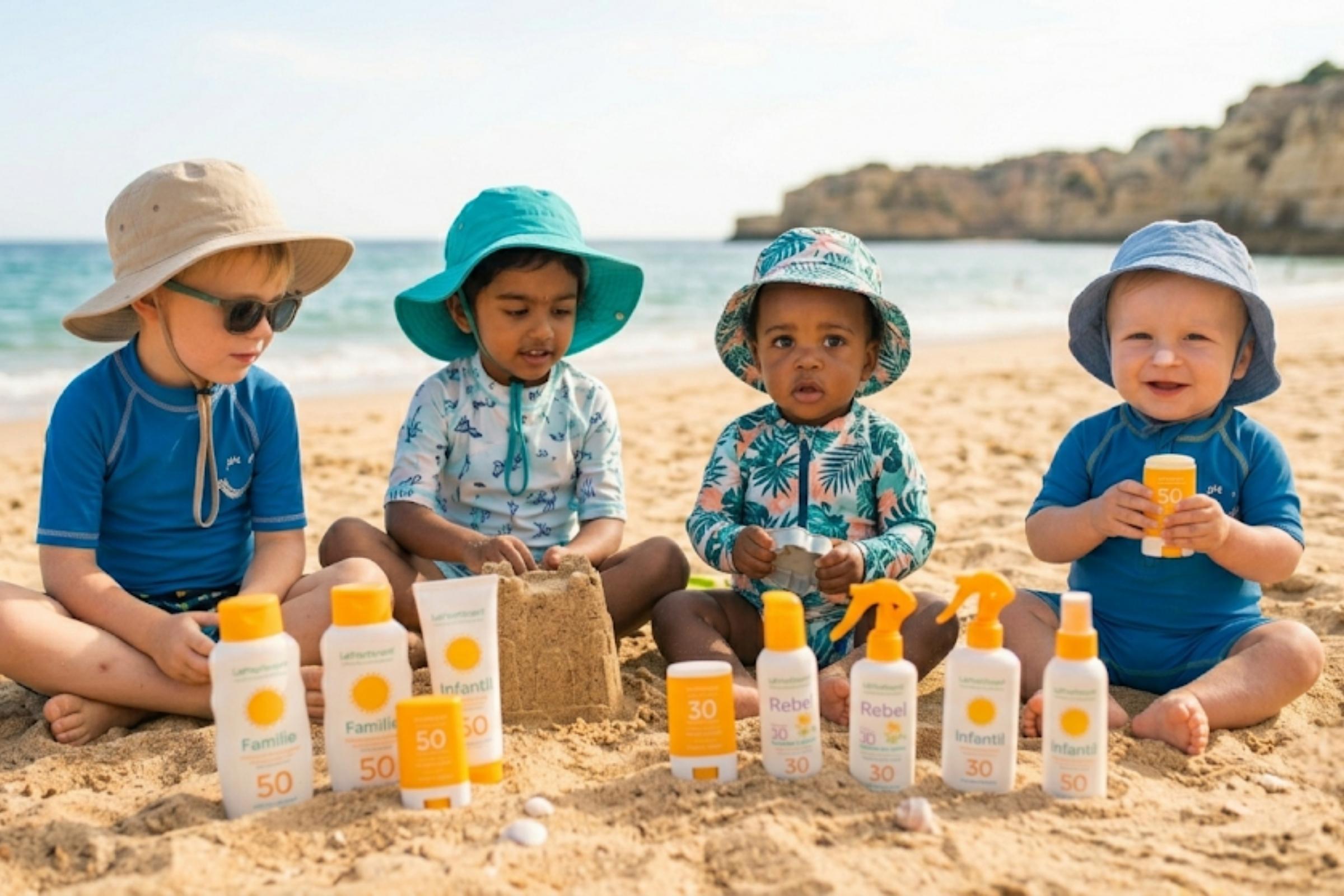
Children's skin is thinner and more sensitive than adults', which makes it especially vulnerable to the effects of the sun. Sunburn in childhood has long-term consequences, so protecting little ones well is one of the most important precautions of the summer. But which sunscreen is the right one, from what age, and how should you apply it? We've gathered all the answers in this guide.
Note: this article is for information only and does not replace the advice of a health professional or pharmacist, particularly for babies or skin prone to allergies.
Which sunscreen should you choose for children?
Look for three essential features on the label:
Broad spectrum: protects against both UVB rays (burning) and UVA rays (ageing and deeper damage). On many labels, UVA protection is shown by the letters "UVA" inside a circle.
SPF 30 to 50+: the sun protection factor indicates the defence against UVB. For children, a high SPF, between 30 and 50+ is recommended.
Made for children and sensitive skin: ideally fragrance-free and formulated to minimise irritation.
Also choose a texture that's easy to apply on a wriggly child: creams, lotions and sticks. All work, as long as they're applied in sufficient quantity.
From what age can you use sunscreen on babies?
The general recommendation is as follows:
Babies under 6 months: should be kept out of direct sunlight. Protection comes from shade and suitable clothing, not from sunscreen. It should only be used on small exposed areas (such as the face or hands) when there's genuinely no alternative.
From 6 months: an age-appropriate sunscreen can be used, without ever giving up shade, a hat and sun-protective clothing.
If you're unsure about a particular baby, the paediatrician or pharmacist is the best point of reference.
Mineral or chemical: which is best for children's skin?
There are two main types of filter. Mineral (or physical) filters, based on zinc oxide or titanium dioxide, form a barrier that reflects radiation and tend to be gentler, which is why they are often preferred for the sensitive skin of babies and children. Chemical filters absorb radiation and usually have a lighter texture that's easier to spread.
Both protect! But for the youngest children and for reactive skin, many professionals suggest mineral options. If your child has atopic skin or allergies, it's worth confirming your choice with the doctor.
How do you apply sunscreen correctly?
How you apply it matters as much as the product you choose:
Apply generously. Most people apply less than is needed, which reduces the real protection.
Apply 15 to 30 minutes before going out, so the product has time to work.
Don't forget the commonly missed spots: ears, nape and neck, tops of the feet, backs of the knees, hands and around the face.
Protect the lips with an SPF lip balm.
Avoid the eye area: there, favour a hat and sunglasses instead.
How often should you reapply?
Reapply every 2 hours and always after a child gets wet, swims, sweats heavily or rubs with a towel. No sunscreen is fully "waterproof": a "water-resistant" label only means it keeps some protection for a limited time in water, so reapplying after a swim is essential.
Is sunscreen enough to protect from the sun?
No. Sunscreen is one layer of protection, but it should never be the only one. The most effective protection combines several precautions: avoiding the sun during the most intense hours (11am to 5pm), seeking shade, and using a wide-brimmed hat, UV-protection sunglasses and sun-protective clothing. It's the sum of all this that truly protects a child.
Keep in mind, too, that UV rays pass through clouds, so even on overcast days protection is still needed, and that water and sand reflect radiation, increasing exposure at the beach and pool.
Extra precautions that make a difference
A few details that often go unnoticed:
Check the expiry date and respect the period-after-opening shown on the bottle.
Don't leave sunscreen in the sun or in a hot car, as heat degrades the filters.
Do a patch test on a baby or sensitive skin: apply a small amount to the forearm the day before and check for any reaction.
What should you do if a child gets sunburnt?
For mild sunburn, take the child to a cool, shaded place, cool the skin with damp compresses or a lukewarm bath, hydrate them with fluids and apply a gentle moisturiser (avoiding harsh products). Don't burst any blisters.
Seek medical help if the burn is extensive, blistered, or if the child has a fever, feels unwell or is in a lot of pain, and in the case of a baby, any sunburn should be assessed by a professional.
On the days you need support to make sure these precautions don't slip — the shade, the reapplication, the hydration — having someone you trust helps. That's also what our Baby Sisters are for.
Frequently asked questions
What SPF should I use on children? A high protection factor, between SPF 30 and 50+, broad spectrum (UVA and UVB) and made for sensitive skin.
From what age can I put sunscreen on a baby? Generally from 6 months. Before that, the baby should be kept out of direct sunlight, in the shade and in suitable clothing, using sunscreen only on small exposed areas and when there's no alternative.
How often should you reapply sunscreen? Every 2 hours, and always after a child gets wet, swims, sweats heavily or rubs with a towel.
Mineral or chemical sunscreen for children? Both protect, but mineral filters (zinc oxide, titanium dioxide) tend to be gentler and are often preferred for the sensitive skin of babies and children. For atopic skin or allergies, confirm with the doctor.
Is sunscreen enough to protect from the sun? No. It should be combined with shade, a hat, sunglasses, sun-protective clothing and reduced exposure during the hottest hours.